What Owning a Dog Teaches Us About IT Service Management
Rich Petti, ITIL Master, explains why choosing IT frameworks is like choosing a dog breed - and how portfolio management is the key to ITSM success.

Rich Petti
Contributor

Key Takeaways
- No single best practice or framework is universally superior - the right choice depends on your organization's unique context.
- Like choosing the right dog breed for your family, selecting IT frameworks requires matching purpose, culture, and capability.
- Most organizations need a portfolio of best practices and standards - not just one - to support their workflows and value streams.
- Best practices and standards themselves require service management: strategy, adoption, maintenance, and continual improvement.
- An integrated Portfolio Management approach is the most mature way to govern your organization's mix of practices and standards.
“Best practices are not one-size-fits-all solutions. Just as no single dog breed is right for every family, no single framework is right for every organization. The real discipline is in thoughtful selection, strategic adoption, and the ongoing care required to make any practice truly your own.”
** - Rich Petti - ITIL Master, Ambassador & Assessor | PassionIT Group**
Introduction: Passion, Pets, and Practices
We are all passionate when it comes to the types of house pets we may choose to own. Emotions run high when you decide to add one to the family, caring for it takes time out of every family member’s life, and it is very emotional when the time arrives to say goodbye.
IT practitioners are similarly passionate about the best practices they choose to use to perform the work of IT Service Management (ITSM). Before we explore that connection, let’s establish two working definitions that anchor this discussion:
IT Service Management (ITSM)
“Managing IT as a business in support of the business, using a collection of best practices and standards to manage a portfolio of IT products and services that add value to business products and services.”
Working definition - Rich Petti, ITIL Master
Digital Product & Service Management (DPSM)
“A set of specialized organizational capabilities for enabling value for customers in the form of digital products and services.”
Source: ITIL®
As technology evolves, there is a meaningful shift happening from traditional ITSM toward the broader concept of Digital Product & Service Management (DPSM). Both require the same disciplined, thoughtful approach to selecting and managing the frameworks that guide them.
The Dog Analogy: Choosing the Right Breed for Your Family

My wife and I love dogs. We have had our fair share of joy adopting and caring for them, and the heartbreak when the time comes to part. Our family’s first dog was a Golden Retriever who was with us for 17 years, followed by a Newfoundland, and later two Bernese Mountain Dogs.
We enjoy watching dog shows and have learned that each breed exists for a specific purpose. A dog may have been bred to guard, guide, hug, hunt, herd, haul, hound, rescue, retrieve, track, or some combination of those characteristics. Each dog in a breed, and within its litter, has its own personality and temperament.

One breed may be more suitable for one type of home. Others may be better with children or seniors, serve best as a companion, or complement a particular lifestyle. They need to fit in with the family, and the whole family needs to adjust to living together. Over time, an adorable puppy grows and needs daily care and love from every member of the household.
“In business, we choose best practices, standards, or a combination of them for the work of service management. Due to each organization’s unique mix of capabilities, resources, culture, and customers, the practices that work for one organization will rarely be the exact same playlist that works for another, even a similar one.”
- Rich Petti, ITIL Master
‘That Dog Won’t Hunt’: Why Framework Wars Miss the Point
 Would you ever tell another dog owner that your dog is better than theirs, or that their dog is the wrong choice for them? Like you, other owners have their own individual set of criteria, conditions, and considerations that influenced their choice.
Yet, as seen in social media - sometimes daily - there are many blogs, posts, and comments complimenting or critiquing IT best practices. Practitioners present their favorite framework and occasionally state why theirs is better than another. By design, all best practice frameworks are simultaneously prescriptive (for new users) and non-prescriptive (for more mature organizations), and both applications need to evolve over time.

In May 2005, I joined the conversation on IT best practices, drawing on 35 years of combined IT experience in the military and at two computer manufacturing organizations. At the time, the arm wrestling was primarily between ITIL and COBIT. More than two decades later, I am still in that conversation, and the debate continues with a growing cast of frameworks.
Why Framework Debates Are Misleading
- Best practice frameworks are non-prescriptive by design - they are meant to be adapted, not adopted wholesale.
- A framework is too easily blamed as the root cause of failure, when the real issue is how guidance was selected, interpreted, resourced, and adapted.
- The choice is never truly binary. Organizations thrive when they strategically combine frameworks to fit their unique needs.
- Standards (like ISO) differ from best practices - they are prescriptive, which is why there is far less debate about them.
From Adoption to Adaptation: The Discipline of Selecting Best Practices
A best practice is too easily blamed as the root cause of IT’s failure to meet business, customer, and user expectations. The core reasons this happens are many, and they are not inherently the fault of a non-prescriptive framework. More often, the failure stems from how the guidance was selected, how it was interpreted, how well it was resourced, and how well it was Adapted to enable specific business needs.
Companies that are successful with public frameworks - often starting as experimental, operational, or grassroots efforts - strategically Adopt best practices, then provide the resources needed to create, maintain, and improve their own value streams. Ideally, they optimize first, then automate.
The work of selecting one or more best practices to perform IT Service Management is like choosing, owning, and caring for a pet in your family. Best practices require thoughtful selection, care, and feeding to fit into the corporate family and to make them your own.
Two Archetype Pairs to Align Before Selection
In business, there are two pairs of archetype characteristics for selection of best practices that need to be considered up front and be in concert with each other:
(1) the purpose and capability of the practice needs to be compatible with
(2) the purpose and culture of the business.
Consider best practices and standards as another form of ‘technology’:
Technology
“Technology is the application of scientific knowledge for practical purposes, encompassing both tangible tools (machines, hardware) and intangible systems (software, methods). It drives innovation across industries, improving efficiency, connectivity, and quality of life.”
Source: General working definition
Therefore, from a technological point of view, and as we do with managing IT solutions, management of best practices and standards requires: strategy, design, acquisition, build, transition, operation, delivery, support, and continual improvement effort.
In other words, best practices themselves require service management to remain relevant for your organization.
An Alternative Approach to Performing ITSM / DPSM
Think and Work Holistically
Best practices and standards became so because others before you paved the way and shared their guidance in public frameworks. You may then use them to shape and improve the organization’s proprietary value streams to realize breakthrough performance.
A way to manage IT best practices and standards strategically is through Portfolio Management, and tactically and operationally with the Service Catalog, a Service Request Catalog, and Service Level Agreements. An integrated Portfolio approach is a more mature way to manage the use of all best practices and standards.
ITIL® - Portfolio Management Practice
“The purpose of the Portfolio Management practice is to ensure that the organization has the right mix of programs, projects, products, and services to execute the organization’s strategy within its funding and resource constraints.”
Source: ITIL®
Why Organizations Need a Portfolio of Practices

Businesses will usually require a portfolio of best practices and standards to support their own workflows and value streams. No single framework covers every domain adequately. The following table illustrates one example of how a single organization might map governance areas to their required frameworks:
Service Management Focus | Recommended Frameworks / Standards |
|---|---|
IT Governance | COBIT, ISO37001, ISO38500 |
IT Architecture | TOGAF |
Asset Management | Corporate Asset, ITIL Service Asset, ITAM |
Risk Management | RiskIT, ISO31000 |
ITSM / DPSM | IT4IT, ISO20000 |
Project Management | PRINCE2, PMBOK |
Security & Compliance | ISO27001, GDPR, HIPAA |
Manufacturing | Industry 4.0, ISO9001 |
Financial Management | ITIL Service Finance, GAAP, SOX |
Engineering & Delivery | ITIL Service Design, SAFe, DevOps |
Continual Improvement | PDCA, Lean, Six Sigma, ISO9001 |
This example contains 17 best practices and 10 regulations/standards, plus any additional guidance required by specific stakeholder groups. Thirteen of the total twenty-seven are IT-centric. For co-creation of business value, IT must be cognizant of all twenty-seven when creating outputs and outcomes. An integrated portfolio management approach makes this tractable.
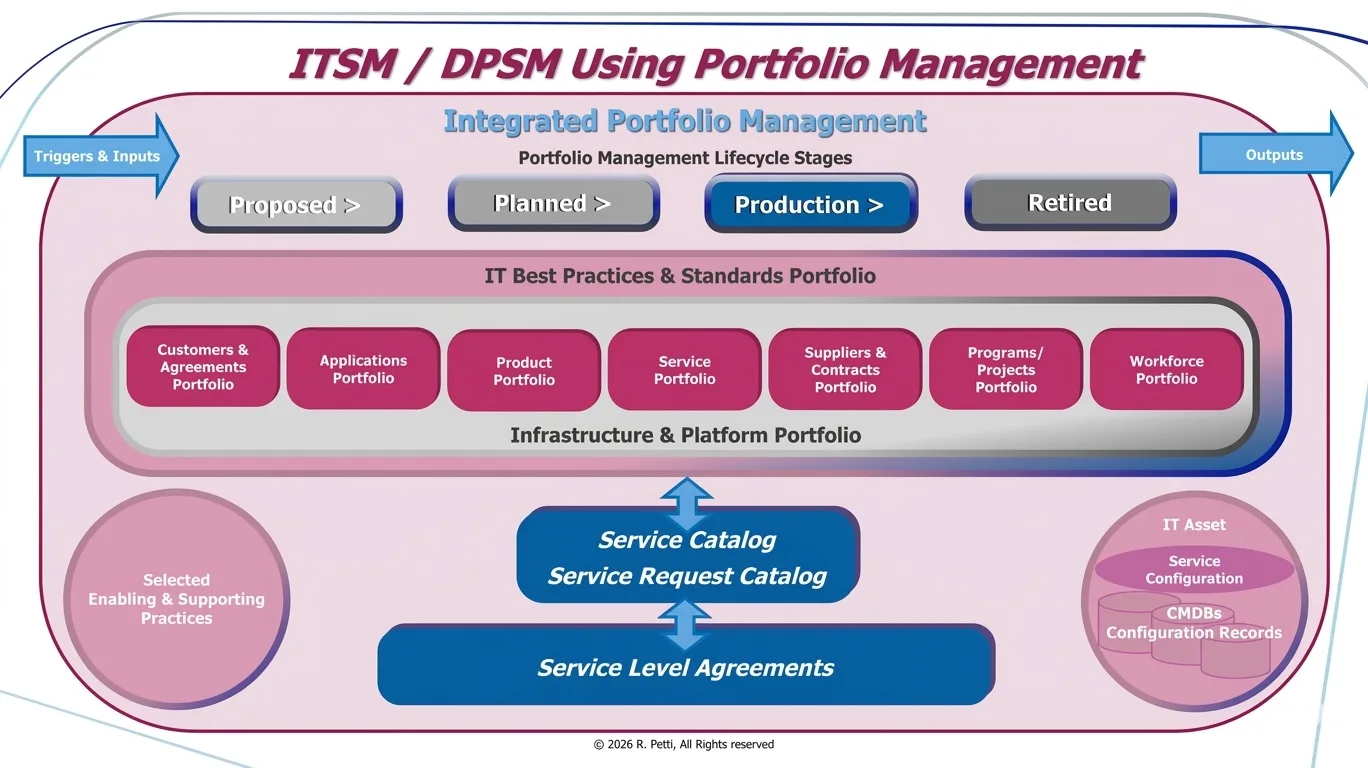
Managing the Portfolio Lifecycle
A formal corporate and IT portfolio management practice should include four lifecycle stages, reviewed no less frequently than quarterly, and reviewed ad hoc as external or internal forces require:
- Proposed or pending review
- Approved, scheduled, and progressing to be in a Portfolio
- Currently in production (operation) with a defined review schedule
- Considered for retirement, or already retired
Classic Portfolio Decisions
- Approval of business plans and charter implementation to enhance or improve existing portfolios/assets
- Retain current assets in a portfolio that meet their current purpose and value
- Rationalize assets by reducing duplicity
- Refactor assets by reducing complexity
- Reprioritize assets to better match business value
- Renew, Refresh, or Replace assets to maintain value
- Repurpose assets to a new role
- Retire and dispose of assets
Key Inputs to Portfolio Practice
- Organizational strategy, resources, funding, and budget
- Analysis of the organization’s key resources
- Analysis of stakeholders and their requirements
- Assessment of the organization’s market position and benchmarking
- Service and product information
- Services and markets risk assessment
- Portfolio management approach, guidelines, and capability
- The organization’s portfolios and initiatives
- Feedback, reports, and suggestions from stakeholders and portfolio reviews
- Value realization and performance data
ITIL® Practices That Support Integrated Portfolio Management
ITIL® is a non-prescriptive, vendor-neutral, technology-agnostic best practice containing a portfolio of thirty-nine practices. In addition to the core portfolio practices, the following ITIL practices should be considered for integrated Portfolio Management for ITSM/DPSM:
- Strategy & Business Analysis
- Project Management
- Relationship Management
- Service Financial Management
- Continual Improvement
- Architecture Management
- Measurement and Reporting
- Knowledge Management
- Service Design
- Supplier Management
- Change Enablement
- Deployment & Release Management
Summary: Bring the Same Care to Practices That You Bring to the Work
It takes a unique combination of best practices and standards for any organization to perform ITSM/DPSM throughout the lifecycle of a business. The business model and operations model canvases are strategic inputs to assist portfolio management in making those choices well.
Key Principles to Carry Forward
- Think holistically and systemically - practices and standards are strategically selected technologies used to manage technology.
- Best practices and standards also require service management principles applied to them.
- Practices and standards are valuable assets that may need to be managed as configuration items for their full lifecycle.
- Apply the same due diligence and discipline used to manage IT solutions when choosing, implementing, and maintaining a hybrid mix of best practices.
- Manage and continually improve the capability of your application of best practices to best fit business-based customer requirements.
- The operational part of all portfolios will drive the contents of the service catalog(s), service request catalog(s), and provide a baseline for service level agreements.
Each IT organization should strategically manage an integrated Portfolio of their preferred collection of IT and non-IT best practices and standards to perform ITSM/DPSM. That portfolio should best support IT’s and the business’s preferred, proprietary, and unique workflows and value streams.
In turn, that will enable IT to fulfill the intended purposes that maximize co-creation of value for the business to operationally, tactically, and strategically achieve the organization’s vision.
ITIL® 4 Foundation
Get started with IT service management through our accredited ITIL 4 Foundation course. In just two days, you'll master the ITIL 4 framework, service value system, guiding principles, and key management practices - preparing you for certification and a successful ITSM career.
- Live, Instructor-led Virtual Class
- Official Exam Voucher Included
- Take2 Re-Sit Option Included
- Office Hours Support
- Digital Course Materials
- Certificate of Completion
FAQs
Frequently Asked Questions
What is IT Service Management (ITSM)?
What is the difference between ITSM and DPSM?
Which ITSM framework is the best - ITIL, COBIT, or another?
How should an organization choose its IT best practices?
What is Portfolio Management in ITIL?
Why do IT best practice implementations fail?
The Writer
About the Author
Rich Petti
Contributor
Rich Petti is an ITIL Master, Ambassador, and Assessor with over 55 years of combined IT experience spanning the military and two major computer manufacturer organizations. He joined the IT best practices conversation in May 2005 and has been a leading voice in ITSM and ITIL adoption, adaptation, and portfolio management ever since. Rich serves as one of PassionIT Group's senior ITIL Master Instructors, bringing real-world depth and strategic clarity to organizations navigating the evolving landscape of IT service and digital product management.
ITIL® Foundation (Version 5)
Get 40% OFF ITIL® Foundation (Version 5). Master AI-driven ITSM through an accredited, two-day instructor-led course. Attend live online from anywhere or join us in person at our training office.
Keep Reading
Related Articles

What Do Jerry Maguire and ITIL Have in Common?
Michelle Alex, ITIL Master at PassionIT Group, uses Jerry Maguire to explain ITIL's core principle of value co-creation and why 'Help me, help you' is the most powerful line in IT service management.

How to Use Your ITIL Foundation Knowledge in a Job Interview
10 real interview questions with conversational answers you can make your own, and actually say across the table with confidence.

From Failure to ITIL Certification: An ITIL Journey Told Through Classic Literature
After failing ITIL CDS, MSF, and Experience exams multiple times, Gab Cahiwat discovered a better study strategy. Learn how reading ITIL like a story helped her pass ITIL certification.
Ready to Advance Your Career?
Join thousands of professionals who have transformed their careers with our expert-led training programs. Get started today and unlock your potential.