Thoughts on ITIL® (Version 5): The New ITIL Value Chain (and What Changed From ITIL 4)
ITIL 5 vs ITIL 4: Insights from Rich Petti, ITIL Master, Ambassador, and Assessor, on the new Value Chain, lifecycle changes, and AI focus.

Rich Petti
Contributor
Are your ears ringing like mine are from the sound of posts about ITIL® (Version 5), thinking that an alarm went off?
Having participated in the beta version of ITIL® 5 and reflecting on it, I thought, why not join the conversation? Here are my initial views about the new release of ITIL.
While working with ITIL® 4 the past few years, I am sometimes asked, “When will there be a new version of ITIL?”
My response was always, “Not sure if they really need to do that. The Four Dimensions, Guiding Principles, Continual Improvement, and Practices in ITIL® 4 have been the same since ITILv31, perhaps they can add one or two Practices, like one for ‘AI’.” Now, seven years later, we have the new ITIL.
Some of the practices/processes we enjoy today have roots in prior versions of ITIL and were expanded in each subsequent edition.
Fast forward to today. ITIL (Version 5) has several changes that enhance it. For those who are interested in certification, especially consultants and trainers, the certification scheme for all three stacks above Foundation requires taking a Transformation course.
The Four Dimensions, Seven Guiding Principles, Five Components of the Value System, and Thirty-Four Practices are the same in the new ITIL as they are in ITIL® 4.
Comparing ITIL® 4 and ITIL® 5 at the architectural level, there is one major, yet very important difference between the two versions:
- The Service Value Chain (SVC) name was revised to be the ITIL Value Chain, to shift the focus of the entire best practice on Digital Product & Service Lifecycle Management
Inside the ITIL Value Chain, there are eight distinct activities that places more focus on organization-specific value streams and practices
ITIL® 5 accomplishes this by changing the SVC‘s nine distinct activities to be eight, clearly articulated, ITIL Value Chain activities in a Product & Service Lifecycle ‘diamond’ and in a ‘stream’ as seen in the figures and table below.
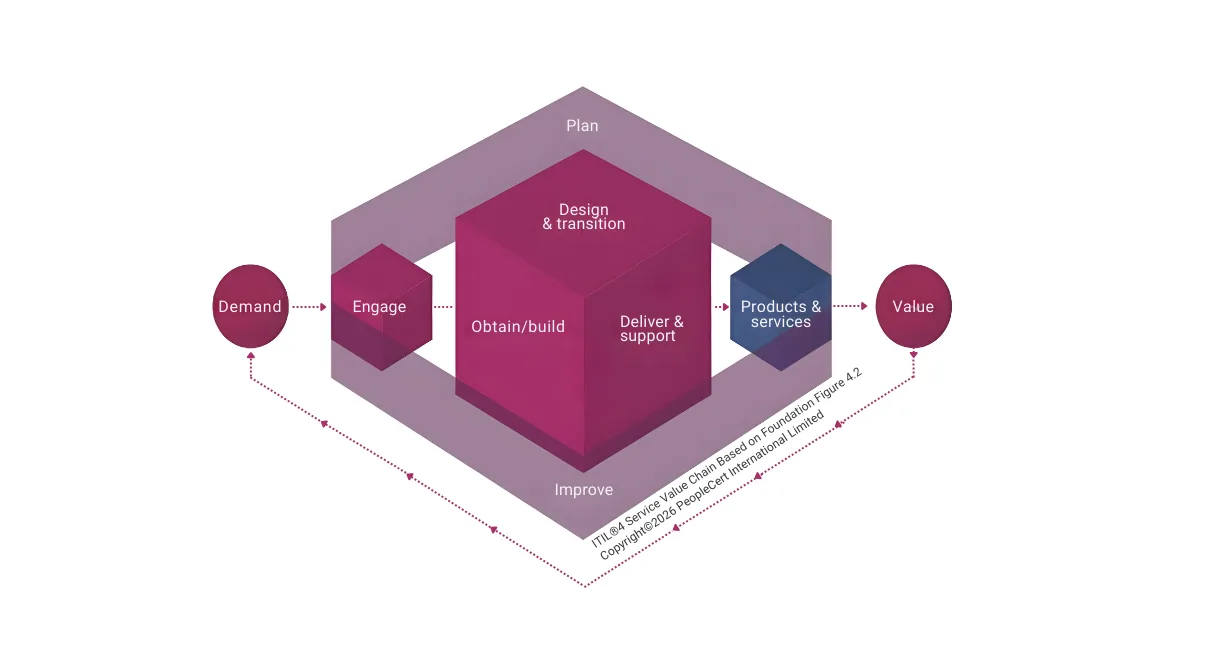 ITIL®4 Service Value Chain Based on Foundation Figure 4.2 Copyright © 2026 PeopleCert International Limited
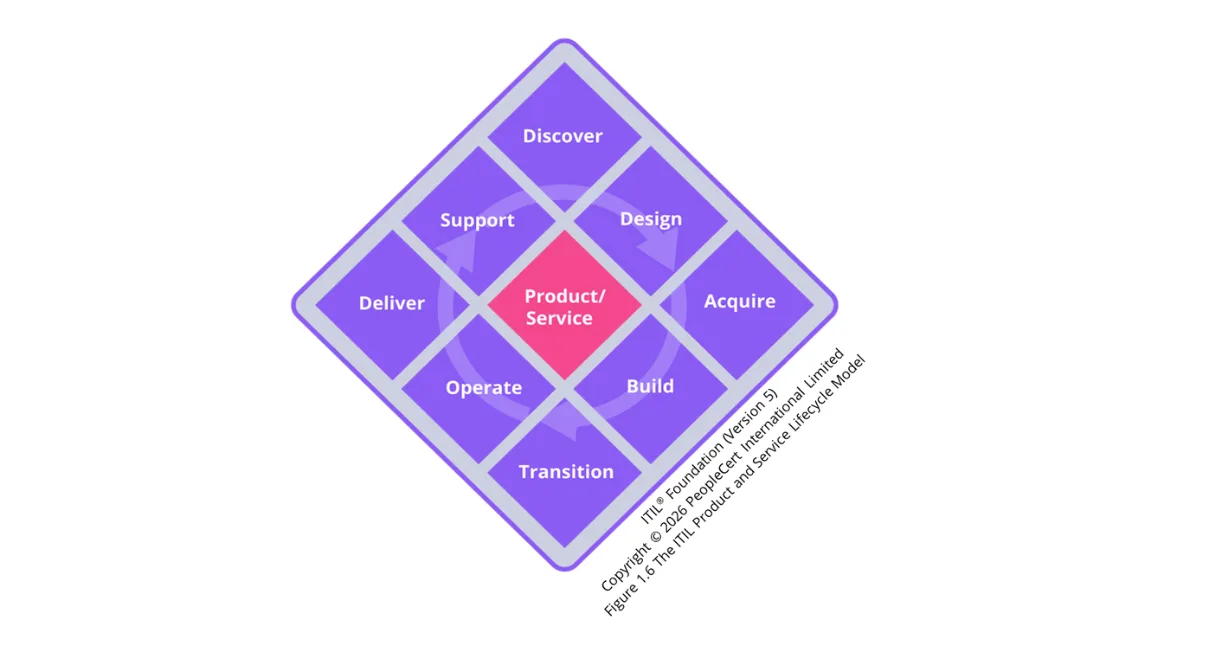 ITIL® Foundation (Version 5) Copyright © 2026 PeopleCert International Limited
Figure 1.6 The ITIL Product and Service Lifecycle Model
ITIL® 4 Service Value Chain’s Nine Distinct Activities | ITIL® 5 ITIL Value Chain Activities from Product & Service Lifecycle Management |
|---|---|
1> Engage | 0.1 |
7> Improve | 0.2 |
2> Plan | #1 of 8. Discover |
3> Design and Transition | #2 of 8. Design |
5> Obtain &/or Build | #3 of 8. Acquire |
6> Obtain &/or Build | #4 of 8. Build |
4> Design and Transition | #5 of 8. Transition |
8> Deliver and Support | #6 of 8. Operate |
8> Deliver and Support | #7 of 8. Deliver |
9> Deliver and Support | #8 of 8. Support |
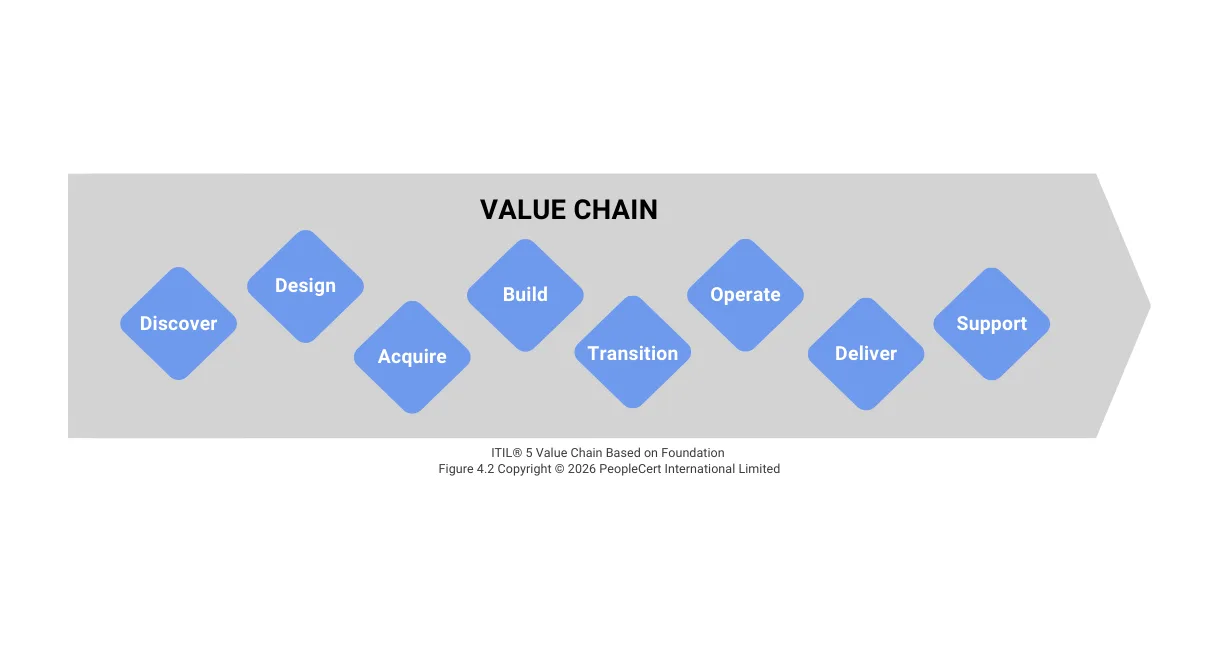 ITIL® 5 Value Chain Based on Foundation Figure 4.2 Copyright © 2026 PeopleCert International Limited
In addition, the conceptual shift in ITIL® 5 includes:
- More focus on AI throughout
- More focus on organization-specific value streams that use Practices
If you choose to take an ITIL® 4 to ITIL® 5 transition course this year, if you understand the major architectural difference is the ITIL Value Chain that focuses on product and service lifecycle management, and that you need to be intentional to build valuable, lean, value streams for your business model, then automate them; you are good to go!
ITIL has always been simultaneously prescriptive guidance for those just starting out and non-prescriptive guidance for those managing a more capable and mature IT organization; so, all types of organizations may then perform Continual Improvement that adds value.
If you choose to use ITIL, choose what to use in it, you will get the most out of it and enjoy the service journey.
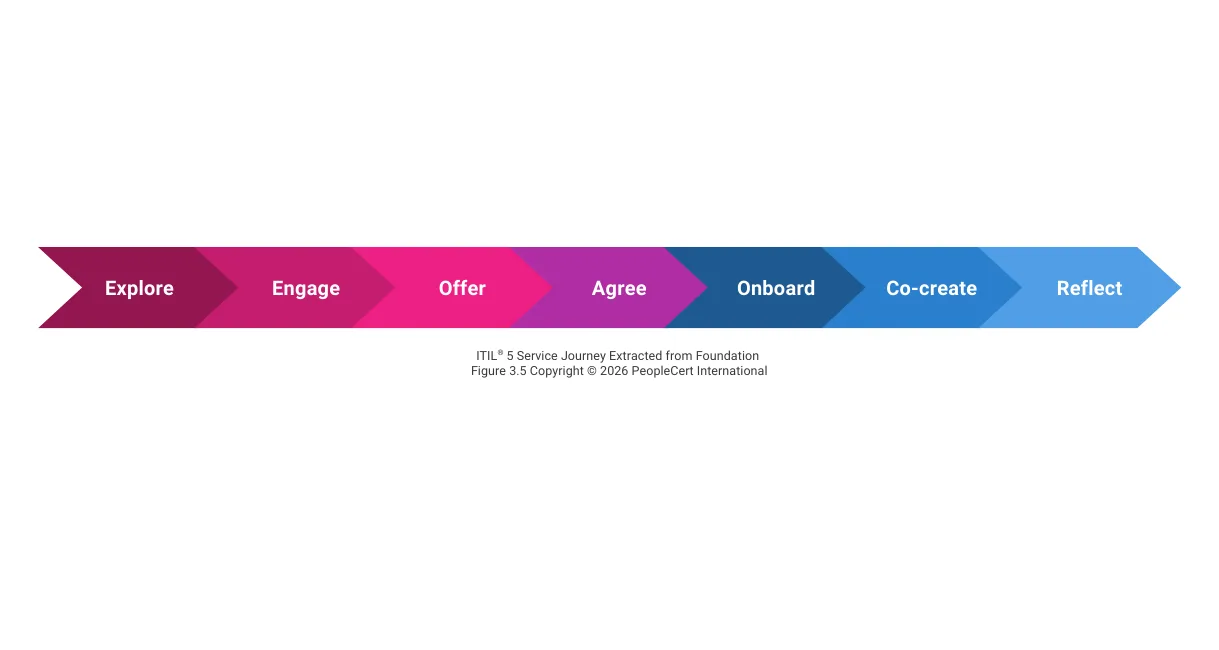 ITIL® 5 Service Journey Extracted from Foundation Figure 3.5 Copyright © 2026 PeopleCert International
Keep it sweet and simple. Just call it ITIL, because that is what ITIL’s personality first was, has been, and still is all about!
1 ITILv3/2011e has Four Ps in Strategy [Perspective, Positions, Plans, Patterns], and in Design [People, Process, Products, Partners]; nine Guiding Principles [Practice Manager textbook & certification]; and the 7-Step Continual Service Improvement Model.
ITIL® Foundation (Version 5)
Get 40% OFF ITIL® Foundation (Version 5). Master AI-driven ITSM through an accredited, two-day instructor-led course. Attend live online from anywhere or join us in person at our training office.
- Live, Instructor-led Virtual Class
- Official Exam Voucher Included
- Take2 Re-Sit Option Included
- Office Hours Support
- Digital Course Materials
- Certificate of Completion
Level Up
Related Courses
ITIL® Foundation (Version 5)
Step into the future of IT Service Management with the brand-new ITIL® Foundation (Version 5) program. Delivered by Chris Ward, ITIL 4 Master and ITIL 5 Advisory Council Member, this course allows you to master the new AI-driven architecture directly from a contributor who helped shape the framework. Choose the learning path that fits your schedule while securing the best value in the industry. <ul class="clean-feature-list"><li><p><i class="fa-solid fa-tag" style="color: var(--color-success); width: 20px;"></i> <strong>40% OFF</strong>: Guaranteed lowest price in the market</p></li><li><p><i class="fa-solid fa-calendar-days" style="color: var(--color-success); width: 20px;"></i> <strong>Flexible Formats</strong>: Choose a 2-Day Live Class, On-Demand, or Standalone Voucher</p></li><li><p><i class="fa-solid fa-ticket" style="color: var(--color-success); width: 20px;"></i> <strong> Complete Package</strong>: Official Exam Voucher, E-book, and Take2 Re-sit Included</p></li><li><p><i class="fa-solid fa-user-shield" style="color: var(--color-success); width: 20px;"></i> <strong> 98% Pass Guarantee</strong>: Backed by 2 full mock exams and expert-led instruction</p></li></ul>
ITIL® Foundation Bridge (Version 5)
The ITIL® Foundation Bridge (Version 5) is designed for professionals who already hold an ITIL® 4 Foundation certification and want to upgrade to ITIL® Version 5. It focuses on the key updates and enhancements in the new framework, including changes to the service value system, guiding principles, and management practices. This course helps you transition efficiently to ITIL® 5 without repeating foundational material.
ITIL® Foundation (Version 5)
Get 40% OFF ITIL® Foundation (Version 5). Master AI-driven ITSM through an accredited, two-day instructor-led course. Attend live online from anywhere or join us in person at our training office.
Keep Reading
Related Articles

What Do Jerry Maguire and ITIL Have in Common?
Michelle Alex, ITIL Master at PassionIT Group, uses Jerry Maguire to explain ITIL's core principle of value co-creation and why 'Help me, help you' is the most powerful line in IT service management.

How to Use Your ITIL Foundation Knowledge in a Job Interview
10 real interview questions with conversational answers you can make your own, and actually say across the table with confidence.

From Failure to ITIL Certification: An ITIL Journey Told Through Classic Literature
After failing ITIL CDS, MSF, and Experience exams multiple times, Gab Cahiwat discovered a better study strategy. Learn how reading ITIL like a story helped her pass ITIL certification.
Ready to Advance Your Career?
Join thousands of professionals who have transformed their careers with our expert-led training programs. Get started today and unlock your potential.